

Connection Comes Before Collaboration
Before collaboration.
Before co-working.
Before strategy, stickies, or breakout groups.
We need connection.
Not the forced, awkward kind. Not the “say your name and a fun fact” kind.
But small, human moments that help people arrive in the moment—together.
Because no matter how thoughtful the agenda is, collaboration falters when people don’t yet feel grounded, respected, or safe enough to contribute honestly.
What psychological safety actually looks like
Psychological safety gets tossed around a lot—but at its core, it’s about this:
• Do I feel present here, instead of distracted by everything outside the room?
• Do I feel comfortable enough to contribute honestly?
• Do I feel respected as an equal to those around me?
People answer these questions, often unconsciously, within the first moments of a convening. And those answers shape how much they speak up, listen, challenge, or stay quiet for the rest of the time together.
This is why the beginning of a workshop matters so much.
And why icebreakers so often miss the mark.
Why icebreakers fall short
Traditional icebreakers tend to ask people to perform instead of connect. They reward quick thinking and extroversion, allow dominant voices to take up space early, and often feel disconnected from the purpose of the gathering.
Even when they’re supposed to be fun they rarely build the conditions required for meaningful collaboration,especially in rooms with power dynamics, mixed familiarity, or cross-organizational stakes.
What does work is designing early moments that invite gentle personal disclosure, movement, and choice,so people can find their own way into connection.
.jpg)
An exercise we return to again and again: Common Threads
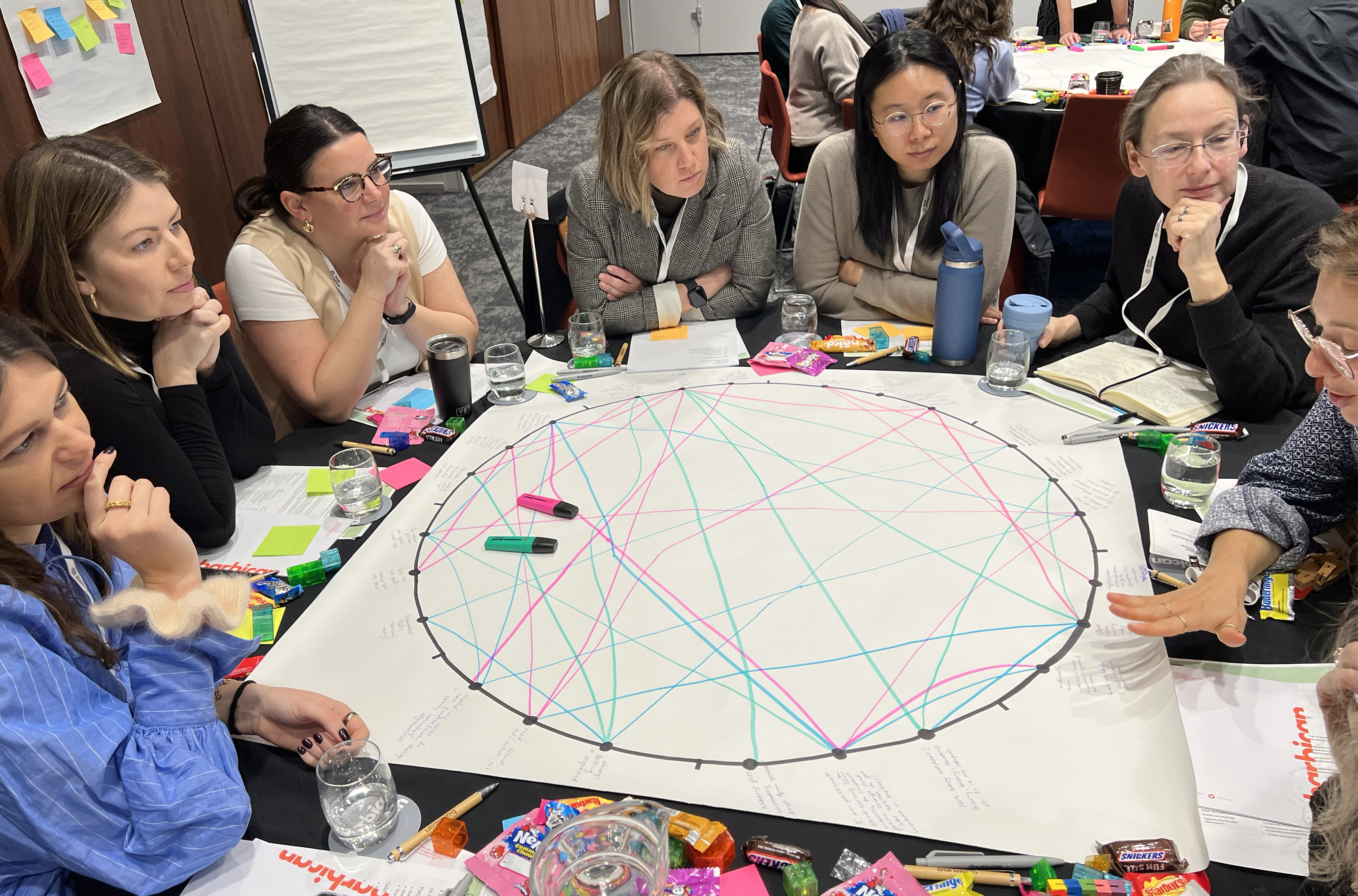
One of the simplest, and most effective, ways we do this is through an exercise we call Common Threads.
Participants respond to personal prompts on a shared circular map and draw lines to others they connect with.
The first time we ran this exercise, it was entirely handmade. We cut down large sheets of white butcher paper, hand-drew the circles, and marked evenly spaced anchor points –simple dots around the perimeter where participants could write their responses.
It was intentionally low-tech, tactile, and flexible.
And it worked immediately.
At first glance, the activity is deceptively simple. In practice, it does a lot of heavy lifting.
What happens in the room
The materials are intentionally inviting: large-scale maps, bright markers, plenty of space to move. The room fills quickly with color, motion, smiles, and laughter.
People circulate. They read. They notice.
And then the lines begin to appear. A few at first, then everywhere.
A few things consistently emerge:
- People who are usually quiet begin to open up
- Conversations spark without prompting
- Laughter replaces tension
- No single person can dominate the activity—it requires equity
- Participants see one another beyond roles and titles
Because everyone is standing, moving, and contributing at the same time, attention is naturally distributed. Hierarchy softens. Presence increases. People become people first, collaborators second.
In multi-day workshops, we often hang the completed maps on the walls. They continue doing quiet work long after the exercise ends, adding color to the space and offering ongoing entry points for conversation.
People stop. Point. Reconnect.
“Oh—you’re the one who also loves that.”
“I didn’t realize we had that in common.”
Why Common Threads works
Common Threads builds psychological safety through design:
- Respect through equality
Everyone contributes in parallel—no one voice sets the tone. - Presence through movement
Getting people out of their seats helps them arrive mentally, not just physically. - Trust through choice
Participants decide what to share and who to connect with. - Humanization beyond roles
Common ground becomes visible before collaboration begins.
We’ve used this exercise with groups like Textile Exchange and the American Museum of Natural History, across leadership teams, cross-sector convenings, and industry-wide gatherings.
Prompt examples
In Common Threads, we intentionally use only three prompts.
Limiting the number of prompts keeps the exercise short, focused, and accessible. The goal isn’t to learn everything about one another, but to create just enough shared context for connection to emerge naturally.
The three prompts are chosen based on how well participants already know one another.
When participants do not know each other, we use grounding, identity-level prompts:
- What you do
- Where you do it
- Why you love what you do
These help people orient quickly, see patterns across the room, and understand who’s here—without requiring vulnerability.
When participants work together but don’t collaborate closely, we shift toward personal texture:
- What I love to do in my free time
- My superpower is…
- What I love about [organization]’s purpose
These prompts reveal the person behind the role and often surface unexpected points of connection.
When participants already know each other, we choose prompts that deepen trust and shared meaning:
- What motivates me to keep doing this work
- A strength I bring to this group
- A perspective I’m trying to grow into
Across all contexts, the structure stays the same. Only the prompts change.
The goal isn’t sameness or consensus, it’s recognition. Seeing yourself reflected somewhere in the room, even briefly, is often enough to shift how people show up next.
When to use it
Common Threads works best early in a workshop or convening, especially with leadership groups or cross-organizational teams. Anytime trust, openness, and honest participation are essential for the work ahead.
Connection doesn’t have to be big or emotional to be meaningful. But it does have to be intentional.
When people feel respected as equals, present in the room, and safe enough to contribute honestly, collaboration becomes easier. Not because the work is simple, but because the people behind the work are ready.
Remember: connection comes before collaboration.
____
We now use Common Threads often enough that we’ve had the maps professionally printed and laminated for sustainable reuse. We use bright dry-erase markers, which keeps the exercise playful and low-pressure—and allows the maps to be wiped clean and used again and again.


