


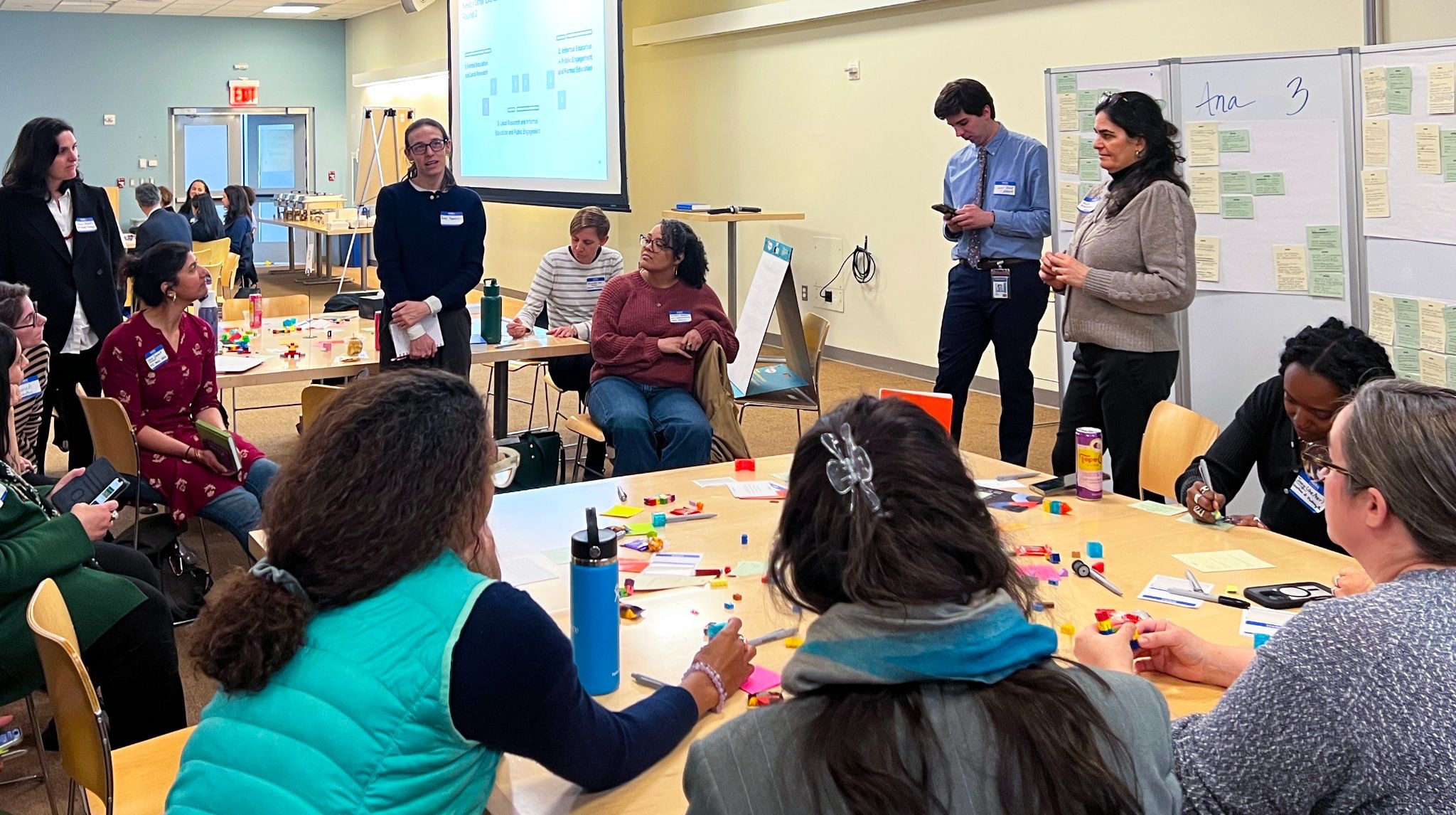
Recently, we partnered with the American Museum of Natural History to design a convening for ~70 scientists, educators, and climate leaders working across New York City.
Like many gatherings, the goal was to bring together people doing important, complex work and help them move it forward.
What emerged from that experience reinforced something we’ve seen again and again: collaboration doesn’t break down because people don’t care or aren’t aligned. In networks like this one, there is often a shared purpose, but there isn’t often a clear way to turn collaborative intent into aligned action.
We want to share one simple practice from that convening that helped close this gap.
Scroll to the end to download our one-page guide for the ‘Needs / Offers’ exercise.
Where climate networks get stuck
Climate action requires collaboration. That part is clear.
What’s less clear is how to turn climate convenings into meaningful collaboration.
In many convenings, the conversation follows a familiar arc. People share what they do, find common ground, and exchange ideas. There’s energy in the room, and often a genuine desire to work together. But the conversation rarely moves into action.
So collaboration tends to stay at the level of interest. It sounds like, “We should work together sometime,” instead of “Here’s something I can do to help you right now.”
Helping people ask for help
We designed our convening using a “Needs / Offers” structure. Instead of general introductions, we asked participants to share: what they’re working on and what they need help with right now. Then we created space for people to respond to one another in real time.
As people started sharing in this framework, the conversation became more grounded. People were navigating real challenges in the current moment like: reaching the right people, securing funding, and making their work visible.
At the same time, the room was full of assets: relationships, expertise, experience, data, and tools. So, we made space for people to make specific offers of help.
As it turned out, what people really needed was often simpler than expected, and those making offers of support realized that a small amount of support could make a big difference for someone else — like a well-timed introduction, access to a dataset, a program to plug into, or a little amplification.
The practice: Needs / Offers
This practice isn’t new. Variations of it show up across facilitation, organizing, and mutual aid spaces. What matters most is how it’s designed and held.
At its core, it helps groups surface real work, normalize asking for help, and create immediate pathways for support.
Here’s how our team at Workshop ran this session:
1. Ground people in real work
We start with a simple invitation:
“What are you working on right now—and what would actually help you move it forward?”
This brings people into their current reality – active projects, real constraints, and tangible next steps.
2. Make needs and offers visible
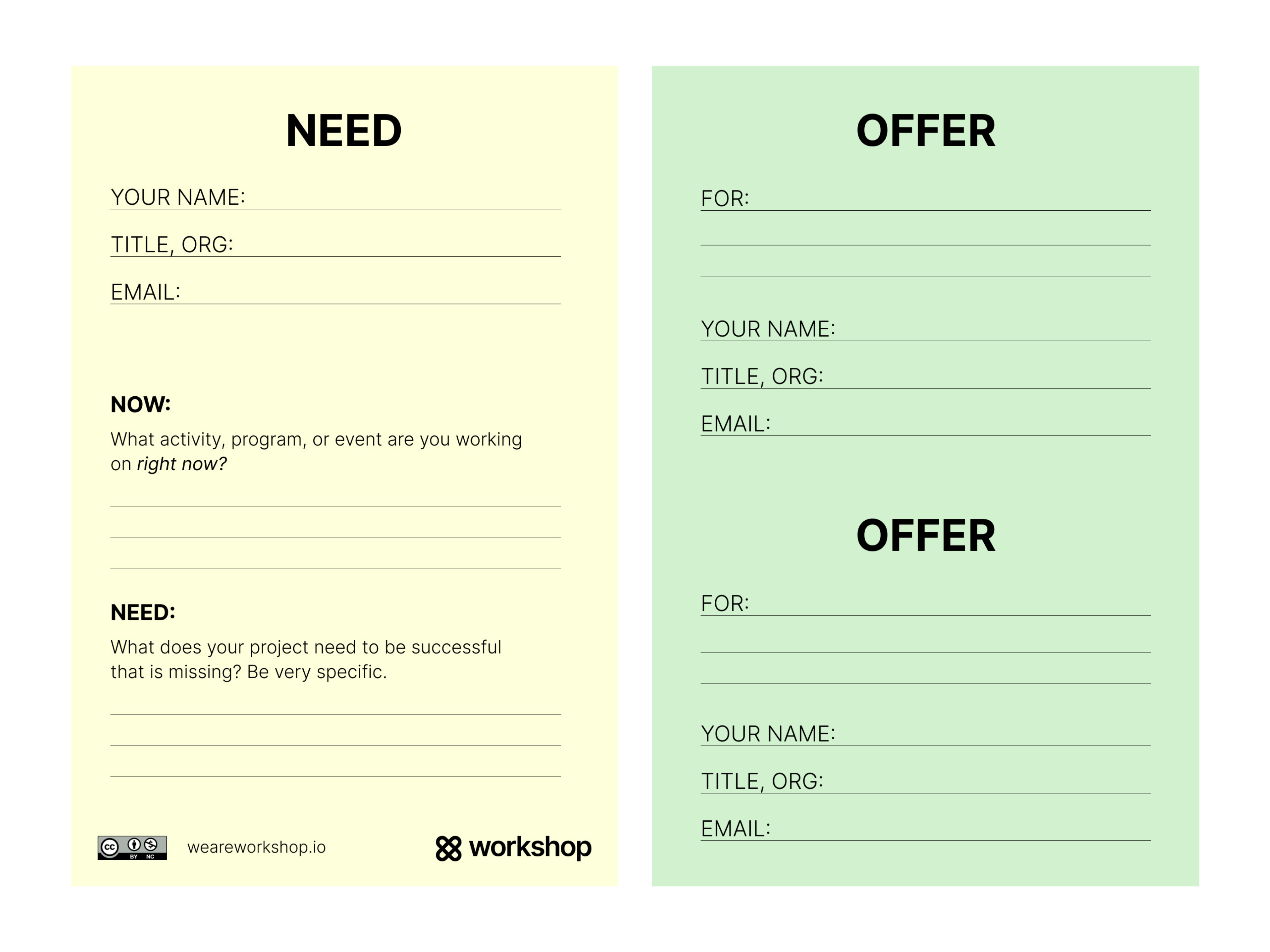
Each participant fills out two simple prompts:
Need
What are you working on?
What do you need to move it forward?
Offer
What do you have access to that could support others?
This moment creates space for reflection. For many, it’s the first time they have clearly articulated what they want from the network.
3. Breakout into small groups
We broke into groups of 8–12 and gathered around a shared board.
Each person shared their work and their needs. As people listened, patterns began to emerge—shared challenges, overlapping efforts, and unexpected connections. It’s a more activated way for everyone to share about themselves and learn about everyone’s work.
4. Respond in real time
After each person shared, the group responded with offers of support.
These are often simple and direct—an introduction, a resource, a relevant experience. Every need was acknowledged.
5. Return to the full group
We brought everyone back together and surfaced any unmet needs.
This created one more opportunity for the room to respond and ensured the exercise carried through to support. We wanted everyone to leave with at least one offer of support.
What this made possible
New connections formed around real work, not just shared interests. People moved more quickly into offering support.
Most groups already have what they need to make progress. The challenge is making that visible and creating the conditions for people to respond to one another in practical ways.
This practice helps people connect real needs with real support.
Download our guide below.


